'How Xi Jinping will withdraw the aggression and justify it to his Communist party in case of a negotiated settlement might be his biggest headache.' 'Unless he is ready to gamble on an armed conflict, whose outcome given India's battle-readiness and determination is always uncertain,' observes Virendra Kapoor.
'We should not worry too much about Indian capabilities, both military and otherwise.'

With Hamid Karzai stonewalling every US effort to conclude a bilateral security agreement, the Obama Administration is pinning its hopes on India to persuade the Afghan President to sign the deal and end the current political imbroglio on the issue.

'We should not flatter ourselves that China is fixated on encircling India. She has greater goals, becoming the pre-eminent power in the world, and India as a major power is dealt with as part of that strategy.'

Could Mumbai have been saved from terror on November 26, 2008? Perhaps, had the intelligence agencies of India, United States and Britain worked together.

The PCB chief called on the Indian High Commissioner at Karachi and apprised him of the security arrangements for the Indian team.
'And this mirror imaging is the most dangerous thing because it leads to tremendous misunderstandings.'

Admiral Sam Locklear heads the US Pacific Command, making him the most powerful military commander on earth. With 60 per cent of the US Navy under him, PACOM oversees 52 per cent of the planet. Locklear is America's military pointsman for 36 countries, including India and China.

India must present its demands of America confidently, instead of fearing that its pocket will somehow be picked, says Ajai Shukla.

US Secretary of State John Kerry, who expressed regret over the arrest and strip-search of Devyani Khobragade, was aware of the senior Indian diplomat's arrest.
'It is advisable for Indian interlocutors to follow the Chinese tactic of repeating the Indian position, both for the record and to test the Chinese negotiator's resolve and intentions.' A riveting excerpt from former foreign secretary Vijay Gokhale's The Long Game: How the Chinese Negotiate With India.

Claude Arpi's fascinating account of the Dalai Lama's arrival in Tawang in March 1959.
'After more than 20 years of understanding, nothing much seems to have been achieved. What the two countries have been trying to do is to manage the recurrence of border incursions. The two sides must address the disease, and not the symptom of the disease,' says Rup Narayan Das.

There's still little indication of forward movement in Indo-US defence relations.

'We have a common way of looking at the world, a common way of thinking, and a common set of values that predispose us to be partners. And our interests overlap greatly,' Dr Ashton B Carter, America's next defence secretary, told Aziz Haniffa/Rediff.com in an exclusive interview.
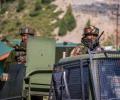
'Why has the peace been kept?' 'Basically because there is a balance.' 'Maybe they think that balance has changed.' 'People can make mistakes. People can miscalculate.' 'If that is the cause, then I think what we have done, matching their build-up, etc, it is giving a good account of ourselves in the face-offs.'

'We are witnessing a spectacle of breathtakingly creative diplomacy at work, riveted on the firm foundations of the country's strategic autonomy,' says Ambassador M K Bhadrakumar.
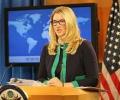
The United States has ruled out acceding to either of the two Indian demands --withdrawal of charges against its diplomat Devyani Khobragade, and an apology for alleged mistreatment, after her arrest in New York last week.

'Those who follow the workings of the establishment believe that Indian diplomacy has managed more by the individual flair and brilliance of a few individuals than its systemic strength or organisational excellence.'

A sensational interview on India-China ties, with the man most qualified to answer.

'If the Americans believed that India is as strong as China or Russia, would they have shown this scant respect for us,' asks Tarun Vijay, MP. 'An economically strong and militarily powerful India would never have had this experience. Not just the Americans, everyone in this world respects might. China receives respect, India gets the law book.'

'If at all,' says Suhasini Haidar, Foreign Affairs Editor, CNN-IBN, 'Devyani Khobragade is to avoid facing a full trial, the process of that negotiation must start immediately, for which the current acrimonious atmosphere must be improved. It is no more than the US was willing to do for Raymond Davis; the Italian government for its sailors; and India for Captain Sunil James and Vijayan in Togo. Devyani Khobragade is not accused of charges anywhere as serious they were, and whether Preet Bharara's office recognises it or not, she is a diplomat who represents a proud country that has taken the insult to her as a personal insult to the country.'
Claude Arpi gives a fascinating firsthand account of the Dalai Lama's arrival in Tawang in March 1959 and explains why he will once again receive a grand welcome, whether Beijing likes it or not.

'India's military posture has become significantly stronger than China's on the 3,500-kilometre Line of Actual Control.' 'This is enhancing confrontation between the two sides,' points out Ajai Shukla.
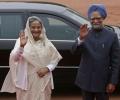
The compulsions of domestic politics notwithstanding, India and Bangladesh script a new story in bilateral relations, say Nayanima Basu and Aditi Phadnis

'If, as appears to be the case, India is on way to 'mending fences' with China, and China is equally desirous to 'reset' the relationship, this could be a self-reflexive moment in India's positioning vis-a-vis not just the Dalai Lama, but also the Tibetan issue and China as a whole,' points out China expert Alka Acharya.
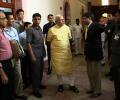
Who are the men the prime minister relies on to execute his impressive agenda?
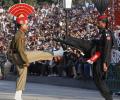
'Pakistan's capacity to carry a normal relationship with India doesn't exist.' 'The relationship with Pakistan is less important than several others.'

'It was almost as though there was widespread relief that the defence bureaucracy, and the minister, could find someone willing to shoulder the blame for everything that had gone wrong with the services under Antony's charge -- the poor preparedness of the forces, slow acquisitions caused by indecision, cancellation of contracts and whimsical blacklisting of defence contractors over the tiniest suspicion that they may have paid speed money or kickbacks.'
